
How does mesalamine (5-ASA) work to induce remission in people with ulcerative colitis.
Almost everyone with ulcerative colitis (UC) is prescribed mesalamine when first diagnosed. Mesalamine is also known as 5-aminosalicylic acid or just 5-ASA for short. This medication is available in various formulations, including oral capsules, enemas, and suppositories, allowing for targeted delivery to the affected areas of the colon. 5-ASA belongs to a class of compounds known as reducing agents, which play a critical role in mitigating oxidative stress within the body. A notable example of another reducing agent is sodium thiosulfate, recognized by the World Health Organization as an essential medicine.
Reducing agents exert their therapeutic effects by neutralizing reactive oxygen species (ROS), which are reactive molecules that can cause cellular damage. In patients with UC, one such ROS—hydrogen peroxide—is produced in excessive quantities within the colon. When hydrogen peroxide (H2O2) accumulates beyond normal levels, it can “leak” out of epithelial cells lining the inner surface of the colon, triggering an immune response. This activation leads to the recruitment of white blood cells called neutrophils to the mucosal surface, resulting in inflammation characteristic of ulcerative colitis.
5-ASA works by neutralizing this H2O2. As long as the medication remains active in the colon, it helps prevent the buildup of hydrogen peroxide and reduces the influx of neutrophils. This process allows the inflammation to subside and symptoms to improve, at least temporarily as long as 5-ASA is present in the colon to neutralize the hydrogen peroxide. So how did 5-ASA come about?
5-ASA was discovered quite by accident. Back in 1940, a Swedish physician named Dr. Nanna Svartz was experimenting with ways to treat inflammatory conditions. She combined two existing drugs: sulfapyridine, an antibiotic, and salicylic acid, which was used to treat arthritis. The result was a new compound called sulfasalazine. When sulfasalazine was given to patients with ulcerative colitis, it surprisingly helped bring their symptoms under control. What’s fascinating is that neither sulfapyridine nor salicylic acid alone had any noticeable effect on UC. It was only when they were chemically linked that the treatment worked.
In 1940, the underlying cause of ulcerative colitis was entirely unknown, and Dr. Nanna Svartz had no reason to believe that combining sulfapyridine with salicylic acid would yield a compound capable of inducing remission. The odds of this discovery were astronomically low—it would be like walking into a vast, pitch-black warehouse and somehow finding the perfect sewing needle (sulfapyridine) and the ideal color thread (salicylic acid), then managing to thread the needle in the dark (sulfasalazine) and eventually ending up with a pair of jeans (5-ASA). This analogy underscores just how unlikely the creation of 5-ASA truly was. You can get an idea of how improbable it was when we examine a simplified version of the synthesis of sulfasalazine and show how it works (mechanism of action).
Synthesis of sulfasalazine:
Step 1: Selecting the right reactants.
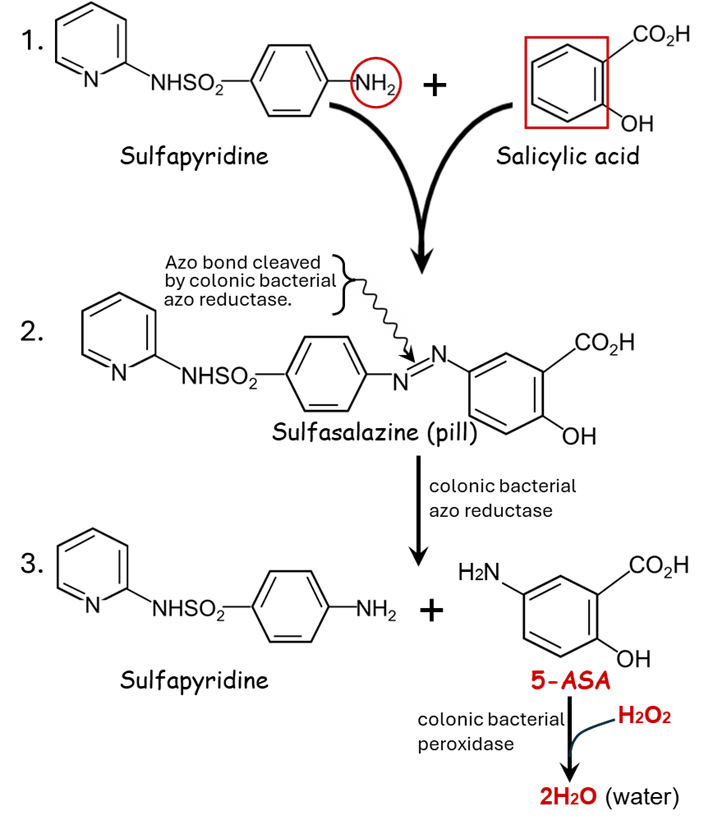
The first step (1) in the synthesis of 5-ASA is to select the right two molecules (sulfapyridine and salicylic acid), which when chemically combined in the laboratory will generate a new molecule (sulfasalazine) (2). The new molecule (sulfasalazine) can be taken orally in pill form and converted by bacterial enzymes (reductase) in the colon to 5-ASA by breaking the azo bond connecting it to sulfapyridine (3).
Once in the colon, 5-ASA can act as a reducing agent to neutralize the excess H2O2 that initiates and perpetuates the inflammation causing ulcerative colitis. Another colonic bacterial enzyme (bacterial peroxidase) accelerates the reaction of 5-ASA with H2O2 to harmless water, which ultimately leads to remission. The oxidized 5-ASA (not shown) is eliminated in the stool.
In 1940, when sulfasalazine was first chemically synthesized no one knew why it was effective in UC. So all the steps involved, starting with the synthesis of sulfasalazine was just pure luck and highly improbable.
Just pure luck.
For sulfasalazine to be created, one of its building blocks—sulfapyridine—had to meet two key requirements. First, it needed to have a specific chemical feature called an amino group (red circle), which allowed it to bond properly with salicylic acid and form the final compound (sulfasalazine). Second, sulfapyridine had to be large enough to prevent the newly formed sulfasalazine from being absorbed too early in the digestive tract. The size mattered because if sulfasalazine were absorbed in the small intestine, it wouldn’t reach the colon, where it’s actually needed. That’s important because 5-ASA, the active part of the drug, doesn’t work when taken by mouth alone—it gets absorbed too soon in the small intestine to have any effect. By attaching it to sulfapyridine, scientists created a way to deliver 5-ASA directly to the colon, where it can help reduce inflammation in people with ulcerative colitis. At the time, this drug delivery requirement was unknown and scientists had no idea that they had satisfied this requirement so the outcome was absolutely pure luck.
Back in 1940, scientists didn’t yet understand the specific chemical features needed to create a therapeutic drug such as sulfasalazine. They had no idea that one of the molecules—sulfapyridine—needed to have just the right size and a special component called an amino group to bond properly with salicylic acid. The odds of choosing sulfapyridine, which happened to meet both of these unknown requirements, was about 1 in infinity.
But that’s not all. For the reaction to work, salicylic acid also had to contain a particular structure known as an aromatic ring (red square). Again, this was completely unknown at the time. So the odds of picking that molecule were also about 1 in infinity. And the chances of selecting both of these molecules—each with the perfect but undiscovered traits—at the same time? Again, that would be 1/infinity or practically zero. It wasn’t even a scientific long shot—because in 1940, the cause of ulcerative colitis was a complete mystery. There was no roadmap, no theory, and no guiding principle to suggest how the disease might be treated, if at all. Any attempt at an effective treatment was slightly less than impossible.
Finally, the chemists presented Dr. Svartz with three different products and she happened to choose sulfasalazine. The chances of choosing the right product was 1 in 3. So, the total probability of synthesizing and selecting sulfasalazine was 1/infinity x 1/infinity x 1/infinity x 1/3. Since 1/infinity approaches zero we can rewrite this as 0 x0 x 0 x 1/3 or more accurately, a value that approaches zero in the limit as infinity gets truly infinite. So the probability of making sulfasalazine were almost nonexistent—about as likely as a miracle.
The right bond:
Sulfasalazine is made of two parts—sulfapyridine and salicylic acid—connected by a special chemical link called an azo bond. This bond is crucial because certain bacteria in the colon produce enzymes called azo reductases that can break the azo bond by adding four electrons— two for sulfapyridine and two for salicylic acid. When salicylic acid receives its electrons, it turns into 5-aminosalicylic acid (5-ASA), a reducing agent that can neutralize H2O2. This removal of H2O2 will allow people with mild UC to go into remission. In 1940, when sulfasalazine was first synthesized this was not known so the selection of an azo bond for the chemical link was just luck.
Newer preparations:
Prior to the 1970s, the therapeutic mechanism by which sulfasalazine achieved remission in UC was unknown. By the late 1970s, it was determined that the therapeutic effects were primarily due to 5-ASA portion, while the sulfapyridine component was responsible for most of the drug’s side effects. This discovery prompted the development of newer 5-ASA formulations that excluded sulfapyridine. Some of these formulations replaced sulfapyridine with an inert carrier molecule, while others utilized pH-sensitive delivery systems designed to release 5-ASA specifically in the alkaline environment of the colon following oral administration. Although 5-ASA was identified as the active therapeutic ingredient, no one knew what it did to induce remission in people with UC.
How 5-ASA works:
In the early 1990s it was discovered that 5-ASA is a reducing agent that can neutralize H2O2.This made sense because a type of white blood cell called neutrophils—known to cause inflammation in UC—produces large amounts of H2O2. It was believed that 5-ASA induced remission by cleaning up the H2O2 secreted by neutrophils. But there was a mystery: once people stopped taking 5-ASA, the colitis returned. We now understand why—it’s not just the neutrophils producing H2O2. The cells lining the inner surface of the colon (colonic epithelial cells) also release H2O2, and when 5-ASA is no longer present, the H2O2 released by these colonic epithelial cells attracts more neutrophils, reigniting the inflammation and colitis. Unfortunately, in the 1990s no one thought of this possibility.
The problem with 5-ASA.
As we have seen, 5-ASA was created by pure luck and not guided by knowledge of what actually causes UC. Because of this, 5-ASA has significant limitations that do not occur in the next generation of reducing agents that are beginning to emerge such as sodium thiosulfate (STS) and R-dihydrolipoic acid (RDLA).
Limitation of 5-ASA
a. Weak reducing agent: The biggest limitation of 5-ASA is that it works best in mild to moderate cases of ulcerative colitis but loses effectiveness in more severe forms of the disease. This is likely due to its chemical nature—5-ASA is a complex aromatic amine with a relatively high redox potential (around +650 mV), which means it doesn’t react well with H2O2 on its own. To function properly, it relies on an enzyme in the colon called peroxidase to help convert H2O2 into harmless water (see Fig. 1). However, like all enzymes, peroxidase has a limit to how fast it can work—a concept known as saturation kinetics. In severe ulcerative colitis, where H2O2 levels are much higher, the enzyme gets overwhelmed and can’t keep up. As a result, 5-ASA becomes less effective in these patients.
In contrast, sodium thiosulfate (STS) reacts directly and immediately with H2O2 in the colon—no enzyme required. With a redox potential of +169 mV, STS is a much stronger reducing agent than 5-ASA, making it effective across all forms of ulcerative colitis, regardless of severity or extent of disease. Put simply, while 5-ASA relies on enzymatic assistance to neutralize H2O2, STS acts independently as a fast-acting chemical reducing agent to neutralize H2O2 on contact. This positions STS as a more effective reducing agent for inducing remission in ulcerative colitis compared to 5-ASA. Provided there are no complicating factors—such as colonic infections or diverticulitis—STS has the potential to induce remission in virtually all individuals with UC.
b. Topical activity: 5-ASA, whether delivered orally, via enema, or as a suppository, exerts its therapeutic effect only when in direct contact with the surface of the colonic mucosa. In other words, its action is strictly localized within the interior of the colon and does not extend beyond that. In contrast, when STS is taken orally, approximately 10% is absorbed into the bloodstream while the remaining 90% continues through the gastrointestinal tract to the colon. The absorbed portion can reach the lamina propria—the tissue surrounding the colonic epithelial cells—via the blood circulation, helping to neutralize H2O2 in that deeper layer. Meanwhile, the unabsorbed majority acts directly within the colon, reducing H₂O₂ levels on the mucosal surface and supporting mucosal healing of superficial ulcers.
In other words, both 5-ASA and STS are capable of neutralizing H2O2 and protecting the colonic mucosa in cases of mild to moderate ulcerative colitis. However, STS remains effective even in severe disease, regardless of the extent of inflammation throughout the colon. Moreover, STS offers a dual advantage: in addition to acting locally within the colon, it can also reach the colonic tissue via the bloodstream, allowing it to target and neutralize H2O2 in deeper layers such as the lamina propria, which accelerates healing.
c. Toxicity: 5-ASA carries a higher risk of certain adverse side effects due to its chemical structure—specifically, the presence of a nitrogen atom and its classification as an aromatic amine (Figure 1, red circle). In contrast, STS is a simple inorganic compound that lacks nitrogen and remains chemically inert within biological systems, thereby avoiding these risks. Serious adverse events associated with 5-ASA include nephrotoxicity, pancreatitis, respiratory failure, white cell aplasia, and myocarditis. Additionally, intolerance to 5-ASA occurs in a subset of patients—up to 15%—with common symptoms including diarrhea, fever, and rash (1). Notably, nearly 30% of hospitalized patients have been reported to exhibit 5-ASA intolerance (2). In contrast, sodium thiosulfate is a simple inorganic salt primarily acting as a reducing agent and sulfur donor. Its side effects are more related to its effects on fluid balance and electrolyte levels, and potentially to allergic reactions in some individuals.
In summary, while both medications have potential side effects, the specific risks associated with 5-ASA are generally greater and influenced by the presence of the nitrogen atom in its structure, its classification as an aromatic amine, and the potential formation of reactive metabolites. STS, being a simple inorganic compound without nitrogen, avoids these risks by staying chemically inert in biological systems.
d. Curability: Both 5-ASA and STS are water-soluble reducing agents that act outside cells, meaning they cannot cross the lipid-rich cell membranes to neutralize H2O2 within colonic epithelial cells. This limitation is significant because ulcerative colitis begins with the overproduction of H2O2 inside these cells. For true cure of the disease to occur, this internal excess of H2O2 must be corrected. In contrast, R-DLA is amphipathic—soluble in both water and lipids—which enables it to be administered orally and transported through the bloodstream to the colon. There, it can readily diffuse into colonic epithelial cells and normalize elevated H2O2 levels. By restoring intracellular redox balance, R-DLA offers a therapeutic mechanism that effectively cures ulcerative colitis.
Are all reducing agents capable of curing ulcerative colitis?
In short, no. Only those that can reach and penetrate colonic epithelial cells and normalize cellular H2O2 (restore intracellular redox homeostasis) hold curative potential. To achieve this, the reducing agent must possess both water and lipid solubility—that is, it must be amphipathic.
5-ASA functions as an enzyme-dependent reducing agent and does not offer a definitive cure for ulcerative colitis. Sodium thiosulfate (STS), a direct-acting chemical reductant that has shown the ability to rapidly induce remission in patients unresponsive to 5-ASA (based on personal observation), also falls short of providing a cure. Although STS exhibits superior reducing capacity, both agents are primarily water-soluble and exert their effects extracellularly. This is a critical limitation, as the root cause of ulcerative colitis lies in the excessive production of H2O2 within colonic epithelial cells.
R-dihydrolipoic acid (RDLA), unlike other agents, is a biologically active reducing compound that is amphipathic—soluble in both water and lipids. This property enables RDLA to diffuse into colonic epithelial cells, where it supports the cell’s intrinsic antioxidant systems in neutralizing excess H2O2 and restoring redox homeostasis. This mechanism offers a curative approach to ulcerative colitis. Much like the daily intake of vitamin C prevents scurvy and gum bleeding, regular administration of RDLA may prevent ulcerative colitis and associated colonic bleeding.
Additionally, individuals recovering from scurvy are not merely in remission; they are considered cured upon taking vitamin C, as it supplies a vital nutrient that human cells are unable to synthesize. In a similar fashion, patients with ulcerative colitis can be regarded as cured when taking RDLA, which delivers the essential reducing equivalents (electrons) their colonic epithelial cells would otherwise produce themselves. These reducing equivalents are necessary to neutralize intracellular H2O2 and restore redox balance.
An analogy to help you remember:
5-ASA, STS, and RDLA are all reducing agents capable of neutralizing hydrogen peroxide. To illustrate the difference in their effectiveness, imagine you’re in a boat that has sprung a leak. Mesalamine (5-ASA) functions like a small pump—it helps remove the incoming water but does nothing to repair the leak itself. As the leak worsens, the pump becomes overwhelmed, unable to keep up with the rising water, and ultimately loses its effectiveness.
RDLA, in contrast, acts like a sealant that can plug the leak. However, it needs to be applied before the boat fills with water—otherwise, it risks being washed away or displaced to an area where it could potentially cause harm to the vessel, possibly exacerbating the condition (such as worsening UC). In other words, RDLA is most effective when the boat is relatively dry—that is, during periods of remission.
If the boat is already filled with too much water for RDLA to be effective, You could use a powerful blowtorch (biologics or JAK inhibitors) to rapidly evaporate the water. However, this approach carries significant risk: because your boat could catch fire (serious adverse effects).
The most sensible approach is to just get a larger pump—sodium thiosulfate—to remove the excess water. Once the boat is dry (remission), you plug the leak with RDLA and shut off the pump. This is what we are trying to do in UC. In this analogy, the colonic epithelium is the boat that is leaking hydrogen peroxide instead of water.
In other words, it doesn’t matter how you get rid of the excess water (big pump, small pump or blow torch). Personally, I favor using the larger pump (sodium thiosulfate) for a few days to clear the water more thoroughly and efficiently, followed by RDLA to seal the leak. For boats at risk of sinking—e.g. patients with severe UC on the verge of hospitalization—there are safe ways to temporarily boost the power of the larger pump, allowing for rapid removal of excess water within hours rather than days if needed.
Once the patient is stable on RDLA, the STS (or 5-ASA) contributes little to the therapeutic effect and can be safely discontinued. That said, continuing 5-ASA poses no harm, though it offers minimal benefit at that stage. In other words, keeping the pump running after the leak has been sealed isn’t harmful—but it’s no longer necessary.
After one to two months on RDLA, a follow-up stool calprotectin test can help evaluate RDLA’s effectiveness and confirm that the ‘leak’ has been sealed. However, it’s important to figure out why the boat sprung a leak in the first place so it doesn’t happen again.
In summary:
The development of 5-ASA was completely serendipitous—a fortunate sequence of events that happened to unfold in the right order. In 1940, sulfasalazine was synthesized by chemically linking sulfapyridine and salicylic acid, based on a misunderstanding of the cause of UC. Despite the flawed rationale, the compound proved effective because it inadvertently transformed salicylic acid—otherwise ineffective for UC—into a reducing agent capable of eliminating excess H2O2 in the colon, thereby inducing remission in patients with mild disease. This breakthrough laid the foundation for the next generation of reducing agents, such as sodium thiosulfate (STS) and R-dihydrolipoic acid (RDLA), which more directly target the underlying cause of UC: elevated intracellular hydrogen peroxide within colonic epithelial cells.
References:
- Mizuno S, et al. 5-Aminosalicylic acid intolerance is associated with a risk of adverse clinical outcomes and dysbiosis in patients with ulcerative colitis. Intestinal research. 2020 Jan 30;18(1):69-78.
- Yusuke, Yoshimatsu; et al. 5-Aminosalicylate intolerance is a risk factor for hospitalization in patients with UC. The American Journal of Gastroenterology 114():p S6-S7, July 2019. | DOI: 10.14309/01.ajg.0000578164.51138.82